The University of Oxford (informally Oxford University, or simply Oxford), located in the City of Oxford, Oxfordshire, United Kingdom, is the oldest university in the English-speaking world. It is also regarded as the best university in the UK according to many of the most recent League tables of British universities.The name is sometimes abbreviated as Oxon. in post-nominals (from the Latin Oxoniensis), although Oxf is sometimes used in official publications. The University has 38 independent colleges and six permanent private halls.
Although the exact date of foundation remains unclear, there is evidence of teaching there as far back as the 11th century. The university grew rapidly from 1167, after English students were banned from attending the University of Paris.After a dispute between students and townsfolk broke out in 1209, some of the academics at Oxford fled north-east to the town of Cambridge, where the University of Cambridge was founded. The two universities (collectively known as "Oxbridge") have since had a long history of competition with each other.
The University of Oxford is a member of the Russell Group of research-led British universities, the G5 Group, the Coimbra Group, the League of European Research Universities, International Alliance of Research Universities and is also a core member of the Europaeum. Academically, Oxford is ranked in the world's top 10 universities.For more than a century, it has served as the home of the Rhodes Scholarship, which brings highly accomplished students from a number of countries to study at Oxford as postgraduates.
History
The University of Oxford does not have a clear date of foundation. Teaching at Oxford existed in some form in 1096.
The expulsion of foreigners from the University of Paris in 1167 caused many English scholars to return from France and settle in Oxford. The historian Gerald of Wales lectured to the scholars in 1188, and the first known foreign scholar, Emo of Friesland, arrived in 1190. The head of the University was named a chancellor from 1201, and the masters were recognised as a universitas or corporation in 1231. The students associated together, on the basis of geographical origins, into two “nations”, representing the North (including the Scots) and the South (including the Irish and the Welsh). In later centuries, geographical origins continued to influence many students' affiliations when membership of a college or hall became customary in Oxford. Members of many religious orders, including Dominicans, Franciscans, Carmelites, and Augustinians, settled in Oxford in the mid-13th century, gained influence, and maintained houses for students. At about the same time, private benefactors established colleges to serve as self-contained scholarly communities. Among the earliest were John I de Balliol, father of the future King of Scots; Balliol College bears his name. Another founder, Walter de Merton, a chancellor of England and afterwards Bishop of Rochester, devised a series of regulations for college life; Merton College thereby became the model for such establishments at Oxford as well as at the University of Cambridge. Thereafter, an increasing number of students forsook living in halls and religious houses in favour of living at colleges.
The new learning of the Renaissance greatly influenced Oxford from the late 15th century onward. Among University scholars of the period were William Grocyn, who contributed to the revival of the Greek language, and John Colet, the noted biblical scholar. With the Reformation and the breaking of ties with the Roman Catholic Church, the method of teaching at the university was transformed from the medieval Scholastic method to Renaissance education, although institutions associated with the university suffered loss of land and revenues. In 1636, Chancellor William Laud, archbishop of Canterbury, codified the university statutes; these to a large extent remained the university's governing regulations until the mid-19th century. Laud was also responsible for the granting of a charter securing privileges for the university press, and he made significant contributions to the Bodleian Library, the main library of the university.
The university was a centre of the Royalist Party during the English Civil War (1642–1649), while the town favoured the opposing Parliamentarian cause. Soldier-statesman Oliver Cromwell, chancellor of the university from 1650 to 1657, was responsible for preventing both Oxford and Cambridge from being closed down by the Puritans, who viewed university education as dangerous to religious beliefs. From the mid-18th century onward, however, the University of Oxford took little part in political conflicts.
History
The coat of arms of the University of Oxford.The University of Oxford does not have a clear date of foundation. Teaching at Oxford existed in some form in 1096.[10]
The expulsion of foreigners from the University of Paris in 1167 caused many English scholars to return from France and settle in Oxford. The historian Gerald of Wales lectured to the scholars in 1188, and the first known foreign scholar, Emo of Friesland, arrived in 1190. The head of the University was named a chancellor from 1201, and the masters were recognised as a universitas or corporation in 1231. The students associated together, on the basis of geographical origins, into two “nations”, representing the North (including the Scots) and the South (including the Irish and the Welsh). In later centuries, geographical origins continued to influence many students' affiliations when membership of a college or hall became customary in Oxford. Members of many religious orders, including Dominicans, Franciscans, Carmelites, and Augustinians, settled in Oxford in the mid-13th century, gained influence, and maintained houses for students. At about the same time, private benefactors established colleges to serve as self-contained scholarly communities. Among the earliest were John I de Balliol, father of the future King of Scots; Balliol College bears his name. Another founder, Walter de Merton, a chancellor of England and afterwards Bishop of Rochester, devised a series of regulations for college life; Merton College thereby became the model for such establishments at Oxford as well as at the University of Cambridge. Thereafter, an increasing number of students forsook living in halls and religious houses in favour of living at colleges.
The new learning of the Renaissance greatly influenced Oxford from the late 15th century onward. Among University scholars of the period were William Grocyn, who contributed to the revival of the Greek language, and John Colet, the noted biblical scholar. With the Reformation and the breaking of ties with the Roman Catholic Church, the method of teaching at the university was transformed from the medieval Scholastic method to Renaissance education, although institutions associated with the university suffered loss of land and revenues. In 1636, Chancellor William Laud, archbishop of Canterbury, codified the university statutes; these to a large extent remained the university's governing regulations until the mid-19th century. Laud was also responsible for the granting of a charter securing privileges for the university press, and he made significant contributions to the Bodleian Library, the main library of the university.
In 1605 Oxford was still a walled city, but several colleges had been built outside the city walls. (North is at the bottom on this map.)The university was a centre of the Royalist Party during the English Civil War (1642–1649), while the town favoured the opposing Parliamentarian cause. Soldier-statesman Oliver Cromwell, chancellor of the university from 1650 to 1657, was responsible for preventing both Oxford and Cambridge from being closed down by the Puritans, who viewed university education as dangerous to religious beliefs. From the mid-18th century onward, however, the University of Oxford took little part in political conflicts.
The mid nineteenth century saw the aftermath of the Oxford Movement (1833-1845) led amongst others by the future Cardinal Newman. The influence of the reformed German university reached Oxford via key scholars such as Jowett and Max Muller.
Administrative reforms during the 19th century included the replacement of oral examinations with written entrance tests, greater tolerance for religious dissent, and the establishment of four colleges for women. Women have been eligible to be full members of the university and have been entitled to take degrees since 7 October 1920.Twentieth century Privy Council decisions (such as the abolition of compulsory daily worship, dissociation of the Regius professorship of Hebrew from clerical status, diversion of theological bequests to colleges to other purposes) loosened the link with traditional belief and practice. Although the University's emphasis traditionally had been on classical knowledge, its curriculum expanded in the course of the 19th century and now attaches equal importance to scientific and medical studies.
Wednesday, September 9, 2009


Monday, August 31, 2009
A network switch is a computer networking device that connects network segments.
The term commonly refers to a Network bridge that processes and routes data at the Data link layer (layer 2) of the OSI model. Switches that additionally process data at the Network layer (layer 3 and above) are often referred to as Layer 3 switches or Multilayer switches.
The term network switch does not generally encompass unintelligent or passive network devices such as hubs and repeaters.
The first Ethernet switch was introduced by Kalpana in 1990.
Function
The network switch, packet switch (or just switch) plays an integral part in most Ethernet local area networks or LANs. Mid-to-large sized LANs contain a number of linked managed switches. Small office, home office (SOHO) applications typically use a single switch, or an all-purpose converged device such as gateway access to small office/home office broadband services such as DSL router or cable Wi-Fi router. In most of these cases, the end user device contains a router and components that interface to the particular physical broadband technology, as in the Linksys 8-port and 48-port devices. User devices may also include a telephone interface to VoIP.
In the context of a standard 10/100 Ethernet switch, a switch operates at the data-link layer of the OSI model to create a different collision domain per switch port. If you have 4 computers A/B/C/D on 4 switch ports, then A and B can transfer data between them as well as C and D at the same time, and they will never interfere with each others' conversations. In the case of a "hub" then they would all have to share the bandwidth, run in Half duplex and there would be collisions and retransmissions. Using a switch is called micro-segmentation. It allows you to have dedicated bandwidth on point to point connections with every computer and to therefore run in Full duplex with no collisions.
Role of switches in networks
Network switch is a marketing term rather than a technical one.[citation needed] Switches may operate at one or more OSI layers, including physical, data link, network, or transport (i.e., end-to-end). A device that operates simultaneously at more than one of these layers is called a multilayer switch, although use of the term is diminishing.[citation needed]
In switches intended for commercial use, built-in or modular interfaces make it possible to connect different types of networks, including Ethernet, Fibre Channel, ATM, ITU-T G.hn and 802.11. This connectivity can be at any of the layers mentioned. While Layer 2 functionality is adequate for speed-shifting within one technology, interconnecting technologies such as Ethernet and token ring are easier at Layer 3.
Interconnection of different Layer 3 networks is done by routers. If there are any features that characterize "Layer-3 switches" as opposed to general-purpose routers, it tends to be that they are optimized, in larger switches, for high-density Ethernet connectivity.
In some service provider and other environments where there is a need for a great deal of analysis of network performance and security, switches may be connected between WAN routers as places for analytic modules. Some vendors provide firewall,network intrusion detection, and performance analysis modules that can plug into switch ports. Some of these functions may be on combined modules.
In other cases, the switch is used to create a mirror image of data that can go to an external device. Since most switch port mirroring provides only one mirrored stream, network hubs can be useful for fanning out data to several read-only analyzers, such as intrusion detection systems and packet sniffers.
Friday, August 14, 2009
 Network security consists of the provisions made in an underlying computer network infrastructure, policies adopted by the network administrator to protect the network and the network-accessible resources from unauthorized access, and consistent and continuous monitoring and measurement of its effectiveness (or lack) combined together.
Comparison with information security
The terms network security and information security are often used interchangeably, however network security is generally taken as providing protection at the boundaries of an organization, keeping the intruders (e.g. black hat hackers, script kiddies, etc.) out. Network security systems today are mostly effective, so the focus has shifted to protecting resources from attack or simple mistakes by people inside the organization, e.g. with Data Loss Prevention (DLP). One response to this insider threat in network security is to compartmentalize large networks, so that an employee would have to cross an internal boundary and be authenticated when they try to access privileged information. Information security is explicitly concerned with all aspects of protecting information resources, including network security and DLP.
Network security concepts
Network security starts from authenticating any user, commonly (one factor authentication) with a username and a password (something you know). With two factor authentication something you have is also used (e.g. a security token or 'dongle', an ATM card, or your mobile phone), or with three factor authentication something you are is also used (e.g. a fingerprint or retinal scan). Once authenticated, a stateful firewall enforces access policies such as what services are allowed to be accessed by the network users.[1] Though effective to prevent unauthorized access, this component fails to check potentially harmful content such as computer worms being transmitted over the network. An intrusion prevention system (IPS)[2] helps detect and inhibit the action of such malware. An anomaly-based intrusion detection system also monitors network traffic for suspicious content, unexpected traffic and other anomalies to protect the network e.g. from denial of service attacks or an employee accessing files at strange times. Communication between two hosts using the network could be encrypted to maintain privacy. Individual events occurring on the network could be tracked for audit purposes and for a later high level analysis.
Honeypots, essentially decoy network-accessible resources, could be deployed in a network as surveillance and early-warning tools. Techniques used by the attackers that attempt to compromise these decoy resources are studied during and after an attack to keep an eye on new exploitation techniques. Such analysis could be used to further tighten security of the actual network being protected by the honeypot.
A useful summary of standard concepts and methods in network security is given by in the form of an extensible ontology of network security attacks.
Security management
Security Management for networks is different for all kinds of situations. A small home or an office would only require basic security while large businesses will require high maintenance and advanced software and hardware to prevent malicious attacks from hacking and spamming.
Small homes
A basic firewall like COMODO Internet Security or a unified threat management system.
For Windows users, basic Antivirus software like AVG Antivirus, ESET NOD32 Antivirus,Kaspersky, McAfee, or Norton AntiVirus. An anti-spyware program such as Windows Defender or Spybot would also be a good idea. There are many other types of antivirus or antispyware programs out there to be considered.
When using a wireless connection, use a robust password. Also try and use the strongest security supported by your wireless devices, such as WPA or WPA2.
If using Wireless: Change the Default SSID network name, also Disable SSID Broadcast; as this function is unnecessary for home use.
Enable MAC Address filtering to keep track of all home network MAC devices connecting to your router.
Assign STATIC IP addresses to network devices.
Disable ICMP ping on router.
Review Router or Firewall logs to help identify abnormal network connections or traffic to the Internet.
Use passwords for all accounts.
Have multiple accounts per family member, using non-administrative accounts for day-to-day activities. Disable the guest account (Control Panel> Administrative Tools> Computer Management> Users).
Raise awareness about information security to children.
Medium businesses
A fairly strong firewall or Unified Threat Management System
Strong Antivirus software and Internet Security Software.
For authentication, use strong passwords and change it on a bi-weekly/monthly basis.
When using a wireless connection, use a robust password.
Raise awareness about physical security to employees.
Use an optional network analyzer or network monitor.
An enlightened administrator or manager.
Large businesses
A strong firewall and proxy to keep unwanted people out.
A strong Antivirus software package and Internet Security Software package.
For authentication, use strong passwords and change it on a weekly/bi-weekly basis.
When using a wireless connection, use a robust password.
Exercise physical security precautions to employees.
Prepare a network analyzer or network monitor and use it when needed.
Implement physical security management like closed circuit television for entry areas and restricted zones.
Security fencing to mark the company's perimeter.
Fire extinguishers for fire-sensitive areas like server rooms and security rooms.
Security guards can help to maximize security.
School
An adjustable firewall and proxy to allow authorized users access from the outside and inside.
Strong Antivirus software and Internet Security Software packages.
Wireless connections that lead to firewalls.
Children's Internet Protection Act compliance.
Supervision of network to guarantee updates and changes based on popular site usage.
Constant supervision by teachers, librarians, and administrators to guarantee protection against attacks by both internet and sneakernet sources.
Large Government
A strong firewall and proxy to keep unwanted people out.
Strong Antivirus software and Internet Security Software suites.
Strong encryption.
Whitelist authorized wireless connection, block all else.
All network hardware is in secure zones.
All host should be on a private network that is invisible from the outside.
Put all servers in a DMZ, or a firewall from the outside and from the inside.
Security fencing to mark perimeter and set wireless range to this.
Wednesday, July 29, 2009
 The United States Army is the branch of the United States armed forces responsible for land-based military operations. It is the largest and oldest established branch of the U.S. military and is one of seven uniformed services. The modern Army has its roots in the Continental Army which was formed on 14 June 1775, before the establishment of the United States, to meet the demands of the American Revolutionary War. Congress created the United States Army on 14 June 1784 after the end of the war to replace the disbanded Continental Army. The Army considers itself to be descended from the Continental Army and thus dates its inception from the origins of that force.
The primary mission of the Army is to "provide necessary forces and capabilities ... in support of the National Security and Defense Strategies."Control and operation is administered by the Department of the Army, one of the three service departments of the Department of Defense. The civilian head is the Secretary of the Army and the highest ranking military officer in the department is the Chief of Staff, unless the Chairman of the Joint Chiefs of Staff or Vice Chairman of the Joint Chiefs of Staff are Army officers. The Regular Army reported a strength of 539,675 soldiers; the Army National Guard (ARNG) reported 360,351 and the United States Army Reserve (USAR) reported 197,024 putting the combined component strength total 1,097,050 soldiers (2008 Financial).
Origins
The Continental Army was created on 14 June 1775 by the Continental Congress as a unified army for the states to fight Great Britain, with George Washington appointed as its commander.The Army was initially led by men who had served in the British Army or colonial militias and who brought much of British military heritage with them. As the Revolutionary war progressed, French aid, resources, and military thinking influenced the new army, while Prussian assistance and instructors also had a strong influence.
George Washington made use of the Fabian strategy and used hit-and-run tactics, hitting where the enemy was weakest, to wear down the British forces and their Hessian mercenary allies. Washington led victories against the British at Trenton and Princeton, and then turned south. With a decisive victory at Yorktown, and the help of the French, the Spanish and the Dutch, the Continental Army prevailed against the British, and with the Treaty of Paris, the independence of the United States was acknowledged.
After the war, though, the Continental Army was quickly disbanded as part of the American distrust of standing armies, and irregular state militias became the new nation's sole ground army, with the exception of a regiment to guard the Western Frontier and one battery of artillery guarding West Point's arsenal. However, because of continuing conflict with Native Americans, it was soon realized that it was necessary to field a trained standing army. The first of these, the Legion of the United States, was established in 1791.
19th century
The War of 1812 (1812-1815), the second and last American war against the British, was less successful than the Revolution had been. An invasion of Canada failed, and U.S. troops were unable to stop the British from burning the new capital of Washington, D.C.. However, the Regular Army, under Generals Winfield Scott and Jacob Brown, proved they were professional and capable of defeating a British army in the Niagara campaign of 1814. Two weeks after a treaty was signed, though, Andrew Jackson defeated the British invasion of New Orleans. However this had little effect, as per the treaty both sides returned to the status quo.
Between 1815 and 1860, a spirit of Manifest Destiny struck the United States, and as settlers moved west the U.S. Army engaged in a long series of skirmishes and battles with Native Americans that the colonists uprooted. The U.S. Army also fought the short Mexican–American War, which was a victory for the United States and resulted in territory which became all or parts of the states of California, Nevada, Utah, Colorado, Arizona, Wyoming and New Mexico.
The Civil War (1861-1865) was the most costly war for the United States. After most states in the South seceded to form the Confederate States of America, CSA troops opened fire on the Union-held Fort Sumter in Charleston, South Carolina, starting the war. For the first two years Confederate forces solidly defeated the U.S. Army, but after the decisive battles of Gettysburg in the east and Vicksburg in the west, combined with superior industrial might and numbers, Union troops fought a brutal campaign through Confederate territory and the war ended with a Confederate surrender at Appomatox Courthouse in April 1865. Based on 1860 census figures, 8% of all white males aged 13 to 43 died in the war, including 6% in the North and an extraordinary 18% in the South.
Following the Civil War, the U.S. Army fought a long battle with Native Americans, who resisted U.S. expansion into the center of the continent. But by the 1890s the U.S. saw itself as a potential international player. U.S. victories in the Spanish-American War (1898) and the controversial and less well known Philippine-American War (1898-1913), as well as U.S. intervention in Latin America and the Boxer Rebellion, gained America more land.
20th century
The United States joined World War I (1914-1918) in 1917 on the side of Russia, Britain and France. U.S. troops were sent to the front and were involved in the push that finally broke through the German lines. With the armistice on 11 November 1918, the Army once again decreased its forces.
The U.S. joined World War II after the Japanese attack on Pearl Harbor on 7 December 1941. On the European front, U.S. Army troops formed a significant portion of the forces that captured North Africa and Sicily. On D-Day and in the subsequent liberation of Europe and defeat of Germany, millions of U.S. Army troops played a central role. In the Pacific, Army soldiers participated alongside U.S. Marines in the "island hopping" campaign that wrested the Pacific Islands from Japanese control. Following the Axis surrenders in May (Germany) and September (Japan) of 1945, Army troops were deployed to Japan and Germany to occupy the two defeated nations. Two years after World War II, the Army Air Forces separated from the Army to become the United States Air Force on 18 September 1947 after decades of attempting to separate. Also, in 1948 the Army was desegregated.
However, the end of World War II set the stage for the East-West confrontation known as the Cold War (late 1940s to late 1980s/early 1990s). With the outbreak of the Korean War, concerns over the defence of Western Europe rose. Two corps, V and VII, were reactivated under Seventh United States Army in 1950 and American strength in Europe rose from one division to four. Hundreds of thousands of U.S. troops remained stationed in West Germany, with others in Belgium, the Netherlands and the United Kingdom, until the 1990s in anticipation of a possible Soviet attack.
During the Cold War, American troops and their allies fought Communist forces in Korea and Vietnam (see Domino Theory). The Korean War began in 1950, when the Soviets walked out of a U. N. Security meeting, removing their possible veto. Under a United Nations umbrella, hundreds of thousands of U.S. troops fought to prevent the takeover of South Korea by North Korea, and later, to invade the northern nation. After repeated advances and retreats by both sides, and the Peoples' Republic of China 's entry into the war, a cease-fire returned the peninsula to the status quo in 1953.
The Vietnam War is often regarded as a low point in the Army's record due to the use of drafted personnel, the unpopularity of the war with the American public, and frustrating restrictions placed on the Army by US political leaders (i.e. no invading communist held North Vietnam). While American forces had been stationed in the Republic of Vietnam since 1959, in intelligence & advising/training roles, they did not deploy in large numbers until 1965, after the Gulf of Tonkin Incident. American forces effectively established and maintained control of the "traditional" battlefield, however they struggled to counter the guerrilla hit and run tactics of the communist Viet Cong and the North Vietnamese Army. On a tactical level, American soldiers (and the US military as a whole) never lost a sizable battle.[citation needed] For instance in the Tet Offensive in 1968, the US Army turned a large scale attack by communist forces into a massive defeat of the Viet Cong on the battlefield (though at the time the offensive sapped the political will of the American public) which permanently weakened the guerrilla force; thereafter, most large scale engagements were fought with the regular North Vietnamese Army. In 1973 domestic political opposition to the war finally forced a US withdrawal. In 1975, Vietnam was unified under a communist government.
The Total Force Policy was adopted by Chief of Staff of the Army General Creighton Abrams in the aftermath of the Vietnam War and involves treating the three components of the Army - the Regular Army, the Army National Guard and the Army Reserve as a single force. Believing that no US president should be able to take the United States (and more specifically the US Army) to war without the support of the American people, General Abrams intertwined the structure of the three components of the Army in such a way as to make extended operations impossible, without the involvement of both the Army National Guard and the Army Reserve.
The 1980s was mostly a decade of reorganization. The Army converted to an all-volunteer force with greater emphasis on training and technology. The Goldwater-Nichols Act of 1986 created Unified Combatant Commands bringing the Army together with the other four armed forces under unified, geographically organized command structures. The Army also played a role in the invasions of Grenada in 1983 (Operation Urgent Fury) and Panama in 1989 (Operation Just Cause).
By 1991 Germany was reunited and the Soviet Union was near collapse. The Cold War was, effectively, over. In 1990 Iraq invaded its smaller neighbor, Kuwait. In January 1991 Operation Desert Storm commenced, a U.S.-led coalition which deployed over 500,000 troops, the bulk of them from U.S. Army formations, to drive out Iraqi forces. The campaign ended in total victory for the Army, as Western coalition forces routed an Iraqi Army organized along Soviet lines in just one hundred hours.
After Desert Storm, the Army did not see major combat operations for the remainder of the 1990s. Army units did participate in a number of peacekeeping activities, such as the UN peacekeeping mission in Somalia in 1993, where the abortive Operation Gothic Serpent led to the deaths of eighteen American soldiers and the withdrawal of international forces. The Army also contributed troops to a NATO peacekeeping force in the former Yugoslavia in the middle of the decade.
21st century
After the September 11 attacks, and as part of the Global War on Terror, U.S. and NATO combined arms (i.e. Army, Navy, Air Force, Marine, Special Operations) forces invaded Afghanistan in 2001, replacing the Taliban government.
The Army took part in the combined U.S. and allied invasion of Iraq in 2003. In the following years the mission changed from conflict between regular militaries to counterinsurgency, with large numbers of suicide attacks resulting in the deaths of more than 4,000 U.S. servicemen (as of March 2008) and injuries to thousands more.[7] The lack of stability in the theater of operations has led to longer deployments for Regular Army as well as Reserve and Guard troops.
Thursday, July 9, 2009
 Google search is a web search engine owned by Google Inc. and is the most-used search engine on the Web . Google receives several hundred million queries each day through its various services. Google search was originally developed by Larry Page and Sergey Brin in 1997.
Beyond the original word-search capability, Google Search provides more than 22 special features, such as: synonyms; weather forecasts; time zones; stock quotes; maps; earthquake data; movie showtimes; airports; home listings; sports scores, etc. There are special features for numbers: prices; temperatures; money/unit conversions ("10.5 cm in inches"); calculations ( 3*4+sqrt(6)-pi/2 ); package tracking; patents; area codes; plus rudimentary language translation of displayed pages.
A Google search-results page is ordered by a priority rank called "PageRank" which is kept secret to avoid spammers from forcing their pages to the top. Google Search provides many options for customized search (see below: Search options), such as: exclusion ("-xx"), inclusion ("+xx"), alternatives ("xx OR yy"), and wildcard matching ("*").
The search engine
PageRank
Google's algorithm uses a patented system called PageRank to help rank web pages that match a given search string.The PageRank algorithm computes a recursive score for web pages, based on the weighted sum of the PageRanks of the pages linking to them. The PageRank derives from human-generated links, and is thought to correlate well with human concepts of importance. The exact percentage of the total of web pages that Google indexes is not known, as it is very hard to actually calculate. Previous keyword-based methods of ranking search results, used by many search engines that were once more popular than Google, would rank pages by how often the search terms occurred in the page, or how strongly associated the search terms were within each resulting page. In addition to PageRank, Google also uses other secret criteria for determining the ranking of pages on result lists, reported to be a number over 200.
Search results
Google not only indexes and caches web pages but also takes "snapshots" of other file types, which include PDF, Word documents, Excel spreadsheets, Flash SWF, plain text files, online videos such as YouTube and much more. Except in the case of text and SWF files, the cached version is a conversion to (X)HTML, allowing those without the corresponding viewer application to read the file.
Users can customize the search engine, by setting a default language, using the "SafeSearch" filtering technology and set the number of results shown on each page. Google has been criticized for placing long-term cookies on users' machines to store these preferences, a tactic which also enables them to track a user's search terms and retain the data for more than a year. For any query, up to the first 1000 results can be shown with a maximum of 100 displayed per page.
Non-indexable data
Despite its immense index, there is also a considerable amount of data available in online databases which are accessible by means of queries but not by links. This so-called invisible or deep Web is minimally covered by Google and other search engines. The deep Web contains library catalogs, official legislative documents of governments, phone books, and other content which is dynamically prepared to respond to a query.
Google optimization
Since Google is the most popular search engine, many webmasters have become eager to influence their website's Google rankings. An industry of consultants has arisen to help websites increase their rankings on Google and on other search engines. This field, called search engine optimization, attempts to discern patterns in search engine listings, and then develop a methodology for improving rankings to draw more searchers to their client's sites.
Search engine optimization encompasses both "on page" factors (like body copy, title elements, H1 heading elements and image alt attribute values) and Off Page Optimization factors (like anchor text and PageRank). The general idea is to affect Google's relevance algorithm by incorporating the keywords being targeted in various places "on page", in particular the title element and the body copy (note: the higher up in the page, presumably the better its keyword prominence and thus the ranking). Too many occurrences of the keyword, however, cause the page to look suspect to Google's spam checking algorithms.
Google has published guidelines for website owners who would like to raise their rankings when using legitimate optimization consultants.
Functionality
The Google search engine has many intuitive features making it more functional. This could have played a role in making it as popular as it is today. Google is one of the top ten most-visited websites today.Some of its features include a definition link for most searches including dictionary words, a list of how many results you got on your search, links to other searches (e.g. you misspelled something, it gives you a link to the search results had you typed in the correct search), and many more. It is unknown whether functionality, speed, or luck brought it its peak status.
Search syntax
Google's search engine normally accepts queries as a simple text, and breaks up the user's text into a sequence of search terms, which will usually be words that are to occur in the results, but may also be phrases, delimited by quotations marks ("), qualified terms, with a prefix such as "+", "-", or one of several advanced operators, such as "site:". The webpages of "Google Search Basics" describe each of these additional queries and options.
Google's Advanced Search web form gives several additional fields which may be used to qualify searches by such criteria as date of first retrieval. All advanced queries transform to regular queries, usually with additional qualified terms.
Query expansion
Google applies query expansion to the submitted search query, transforming it into the query that will actually be used to retrieve results. As with page ranking, the exact details of the algorithm Google uses are deliberately obscure, but certainly the following transformations are among those that occur:
Term reordering: in information retrieval this is a standard technique to reduce the work involved in retrieving results. This transformation is invisible to the user, since the results ordering uses the original query order to determine relevance.
Stemming is used to increase search quality by keeping small syntactic variants of search terms
There is a limited facility to fix possible misspellings in queries.
"I'm Feeling Lucky"
Google's homepage includes a button labeled "I'm Feeling Lucky". When a user clicks on the button the user will be taken directly to the first search result, bypassing the search engine results page. The thought is that, if a user is "feeling lucky", the search engine will return the perfect match the first time without having to page through the search results.
According to a study by Tom Chavez of "Rapt", this feature costs Google $110 million a year as 1% of all searches use this feature and bypass all advertising.
Rich Snippets
On 12 May 2009, Google announced that they would be parsing the hCard, hReview and hProduct microformats, and using them to populate search result pages with what they called "Rich Snippets".
Special features
Besides the main search-engine feature of searching for text, Google Search has more than 22 "special features" (activated by entering any of dozens of trigger words) when searching:
synonym search - A search can match words similar to those specified, by placing the tilde sign (~) immediately in front of a search term, such as: ~fast food.
weather - The weather humidity, temperature and forecast, for many cities, can be viewed by typing "weather" followed by the city and state, U.S. zip code, or city and country (such as: weather Lawrence, Kansas; weather Paris; weather Bremen, Germany).
stock quotes - The market data[6] for a specific company or fund can be viewed, by typing the ticker symbol (or include "stock"), such as: CSCO; MSFT; IBM stock; F stock (lists Ford Motor Co.); or AIVSX (fund). Results show inter-day changes, or 5-year graph, etc.
time zone - The current time in many cities (worldwide), can be viewed by typing "time" and the name of the city (such as: time Cairo; time Pratt, KS).
sports scores - The scores and schedules, for sports teams,can be displayed by typing the team name or league name into the search box.
calculator - Calculation results can be determined,as calculated live, by entering a formula in numbers or words, such as: 6*77 +pi +sqrt(e^3)/888 plus 0.45. The user is given the option to search for the formula, after calculation.
unit conversion - Measurements can be converted, by entering each phrase, such as: 10.5 cm in inches; or 90 km in miles
currency conversion - A money or currency converter can be selected, by typing the names or currency codes (listed by ISO 4217): 6789 Euro in USD; 150 GBP in USD; 5000 Yen in USD; 5000 Yuan in lira (the U.S. dollar can be USD or "US$" or "$", while Canadian is CAD, etc.).
dictionary lookup - A definition for a word or phrase can be found, by entering "define" plus the word(s) to lookup (such as: Define philosophy)
maps - Some related maps can be displayed, by typing in the name or U.S. ZIP code of a location and the word "map" (such as: New York map; Kansas map; or Paris map).
movie showtimes - Reviews or film showtimes can be listed for any movies playing nearby, by typing "movies" or the name of any current film into the search box. If a specific location was saved on a previous search, the top search result will display showtimes for nearby theaters for that movie.
public data - Trends for population (or unemployment rates) can be found for U.S. states & counties, by typing "population" or "unemployment rate" followed by a state or county name.
real estate and housing - Home listings in a given area can be displayed, using the trigger words "housing", "home", or "real estate" followed by the name of a city or U.S. zip code.
travel data/airports - The flight status for arriving or departing U.S. flights can be displayed,by typing in the name of the airline and the flight number into the search box (such as: american airlines 18). Delays at a specific airport can also be viewed (by typing the name of the city or three-letter airport code plus word "airport").
package tracking - Package mail can be tracked by typing the tracking number of a UPS, Fedex or USPS package directly into the search box. Results will include quick links to track the status of each shipment.
patent numbers - U.S. patents can be searched by entering the word "patent" followed by the patent number into the search box (such as: Patent 5123123).
area code - The geographical location (for any U.S. telephone area code) can be displayed by typing a 3-digit area code (such as: 650).
U.S. Government search - Searching of U.S. government websites can be performed from webpage: www.google.com/ig/usgov.
Saturday, July 4, 2009
 The term digital signal is used to refer to more than one concept. It can refer to discrete-time signals that have a discrete number of levels, for example a sampled and quantified analog signal, or to the continuous-time waveform signals in a digital system, representing a bit-stream. In the first case, a signal that is generated by means of a digital modulation method is considered as converted to an analog signal, while it is considered as a digital signal in the second case.
An analog signal is a datum that changes over time—say, the temperature at a given location; the depth of a certain point in a pond; or the amplitude of the voltage at some node in a circuit—that can be represented as a mathematical function, with time as the free variable (abscissa) and the signal itself as the dependent variable (ordinate). A discrete-time signal is a sampled version of an analog signal: the value of the datum is noted at fixed intervals (for example, every microsecond) rather than continuously.
If individual time values of the discrete-time signal, instead of being measured precisely (which would require an infinite number of digits), are approximated to a certain precision—which, therefore, only requires a specific number of digits—then the resultant data stream is termed a digital signal. The process of approximating the precise value within a fixed number of digits, or bits, is called quantization.
In conceptual summary, a digital signal is a quantized discrete-time signal; a discrete-time signal is a sampled analog signal.
In the Digital Revolution, the usage of digital signals has increased significantly. Many modern media devices, especially the ones that connect with computers use digital signals to represent signals that were traditionally represented as continuous-time signals; cell phones, music and video players, personal video recorders, and digital cameras are examples.
In most applications, digital signals are represented as binary numbers, so their precision of quantization is measured in bits. Suppose, for example, that we wish to measure a signal to two significant decimal digits. Since seven bits, or binary digits, can record 128 discrete values (viz., from 0 to 127), those seven bits are more than sufficient to express a range of one hundred values.
Waveforms in digital systems
In computer architecture and other digital systems, a waveform that switches between two voltage levels representing the two states of a Boolean value (0 and 1) is referred to as a digital signal, even though it is an analog voltage waveform, since it is interpreted in terms of only two levels.
The clock signal is a special digital signal that is used to synchronize digital circuits. The image shown can be considered the waveform of a clock signal. Logic changes are triggered either by the rising edge or the falling edge.
The given diagram is an example of the practical pulse and therefore we have introduced two new terms that are:
Rising edge: the transition from a low voltage (level 1 in the diagram) to a high voltage (level 2).
Falling edge: the transition from a high voltage to a low one.
Although in a highly simplified and idealised model of a digital circuit we may wish for these transitions to occur instantaneously, no real world circuit is purely resistive and therefore no circuit can instantly change voltage levels. This means that during a short, finite transition time the output may not properly reflect the input, and indeed may not correspond to either a logically high or low voltage.
Logic voltage levels
The two states of a wire are usually represented by some measurement of an electrical property: Voltage is the most common, but current is used in some logic families. A threshold is designed for each logic family. When below that threshold, the wire is "low," when above "high." Digital circuits establish a "no man's area" or "exclusion zone" that is wider than the tolerances of the components. The circuits avoid that area, in order to avoid indeterminate results.
It is usual to allow some tolerance in the voltage levels used; for example, 0 to 2 volts might represent logic 0, and 3 to 5 volts logic 1. A voltage of 2 to 3 volts would be invalid, and occur only in a fault condition or during a logic level transition. However, few logic circuits can detect such a condition and most devices will interpret the signal simply as high or low in an undefined or device-specific manner. Some logic devices incorporate schmitt trigger inputs whose behaviour is much better defined in the threshold region, and have increased resilience to small variations in the input voltage.
The levels represent the binary integers or logic levels of 0 and 1. In active-high logic, "low" represents binary 0 and "high" represents binary 1. Active-low logic uses the reverse representation.
Sunday, June 28, 2009
 The cathode ray tube (CRT) is a vacuum tube containing an electron gun (a source of electrons) and a fluorescent screen, with internal or external means to accelerate and deflect the electron beam, used to create images in the form of light emitted from the fluorescent screen. The image may represent electrical waveforms (oscilloscope), pictures (television, computer monitor), radar targets and others.
Color CRTs have three separate electron guns (shadow mask) or electron guns that share some electrodes for all three beams (Sony Trinitron, and licensed versions)
The CRT uses an evacuated glass envelope which is large, deep, heavy, and relatively fragile. Display technologies without these disadvantages, such as flat plasma screens, liquid crystal displays, DLP, OLED displays have replaced CRTs in many applications and are becoming increasingly common as costs decline.
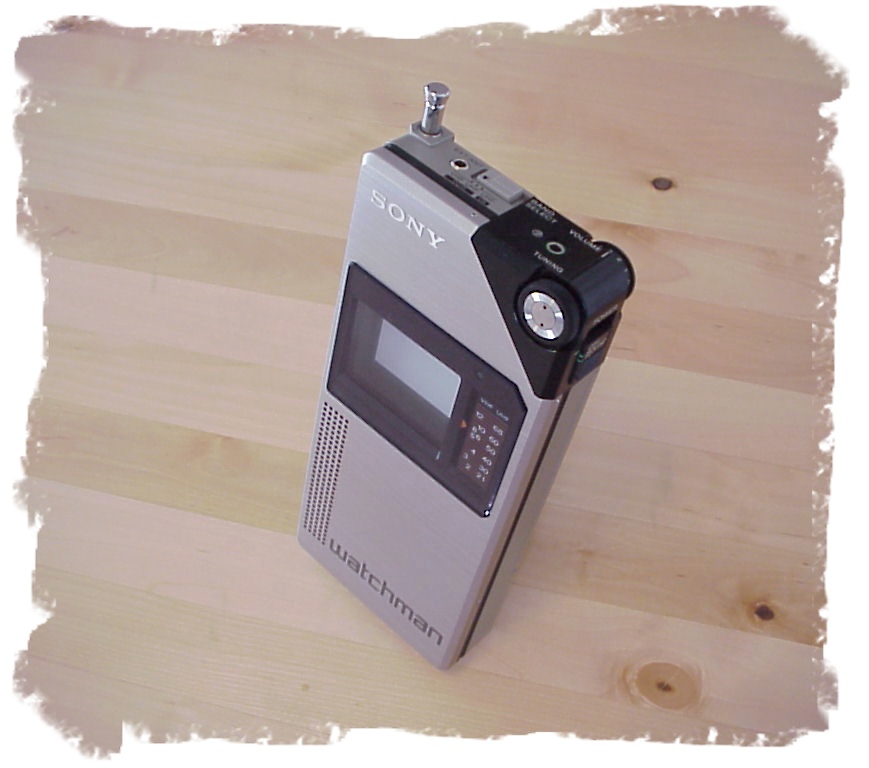
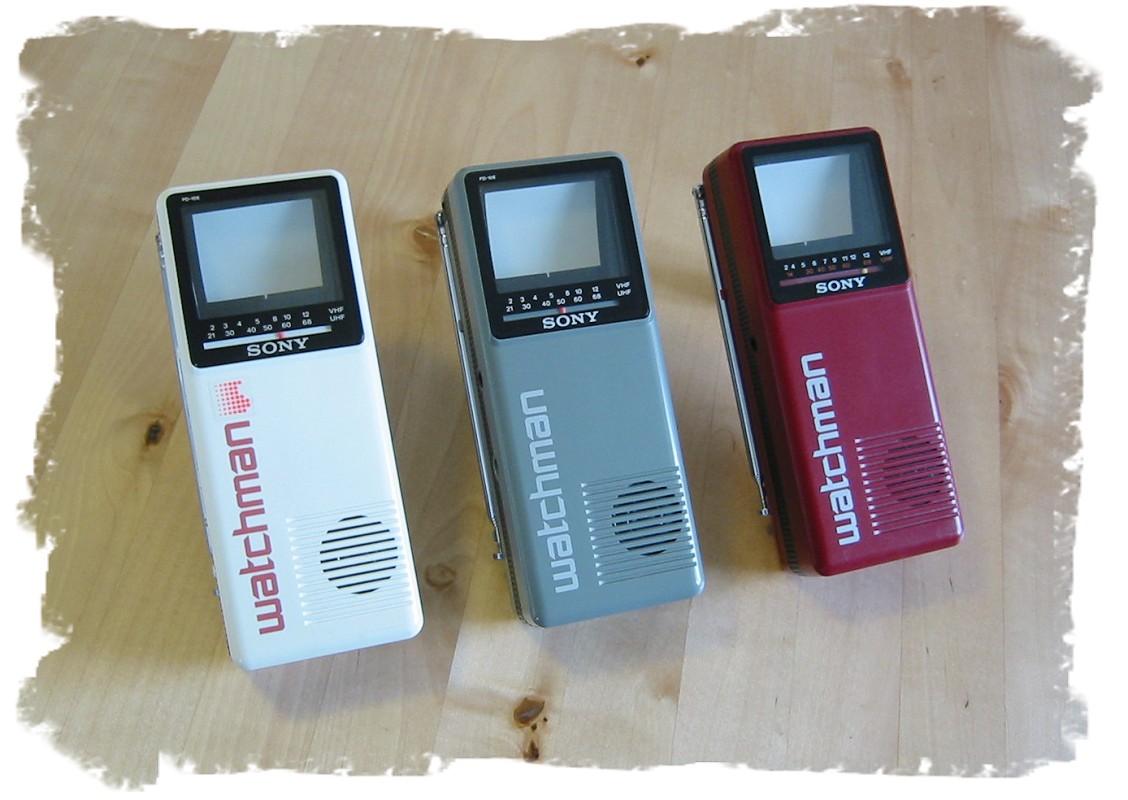
An exception to the typical bowl-shaped CRT would be the flat CRTs used by Sony in their Watchman series (the FD-210 was introduced in 1982). One of the last flat-CRT models was the FD-120A. The CRT in these units was flat with the electron gun located roughly at right angles below the display surface thus requiring sophisticated electronics to create an undistorted picture free from effects such as keystoning.
General description
The earliest version of the CRT was invented by the German physicist Ferdinand Braun in 1897 and is also known as the 'Braun tube'. It was a cold-cathode diode, a modification of the Crookes tube with a phosphor-coated screen. The first version to use a hot cathode was developed by John B. Johnson (who gave his name to the term Johnson noise) and Harry Weiner Weinhart of Western Electric, and became a commercial product in 1922.
The cathode rays are now known to be a beam of electrons emitted from a heated cathode inside a vacuum tube and accelerated by a potential difference between this cathode and an anode. The screen is covered with a crystalline phosphorescent coating (doped with transition metals or rare earth elements), which emits visible light when excited by high-energy electrons. The beam (or beams, in color CRTs) is deflected either by a magnetic or an electric field to move the bright dot(s) to the required position on the screen. External electromagnets deflect the beams magnetically, while internal plates placed near to and alongside the beam deflect it electrostatically. (Electrostatic deflection is used only for single-beam tubes.)
In television sets and computer monitors the entire front area of the tube is scanned repetitively and systematically in a fixed pattern called a raster. A raster is a rectangular array of closely-spaced parallel lines, scanned one at a time, from left to right (and, ever so slightly, "downhill", because the beam is moving steadily down while drawing the image frame). An image is produced by modulating the intensity of each of the three electron beams, one for each primary color (red, green, and blue) with a received video signal (or another signal derived from it). In all CRT TV receivers except some very early models (The earliest commercial TV receivers used electrostatic deflection, even by the end of the 1940s, many of them relying on the famous 7JP4), the beam is deflected by magnetic deflection, a varying magnetic field generated by coils (the deflection yoke), driven by electronic circuits, around the neck of the tube.
CRT details
Oscilloscope CRTs
For use of an oscilloscope, the design is somewhat different from that in a TV or monitor. Rather than tracing out a raster, the electron beam is directly steered along an arbitrary path, while its intensity is kept constant. So electrostatic deflection is used. Usually the beam is deflected horizontally (X) by a varying potential difference between a pair of plates (inside the neck, of course, part of the electron gun) to its left and right, and vertically (Y) by plates (also inside, part of the gun) above and below, although magnetic deflection is possible (but never seen in modern oscilloscopes). The instantaneous position of the beam will depend upon the X and Y voltages. The first commercial CRT, the WE224, was an electrostatic deflection tube, with a soft vacuum, made by Western Electric intended to be used in the first oscilloscopes.
Color CRTs
Color tubes use three different phosphors which emit red, green, and blue light respectively. They are packed together in stripes (as in aperture grille designs) or clusters called "triads" (as in shadow mask CRTs). Color CRTs have three electron guns, one for each primary color, arranged either in a straight line or in a triangular configuration (the guns are usually constructed as a single unit). Each gun's beam reaches the dots of exactly one color; a grille or mask absorbs those electrons that would otherwise hit the wrong phosphor. Since each beam starts at a slightly different location within the tube, and all three beams are perturbed in essentially the same way, a particular deflection charge will cause the beams to hit a slightly different location on the screen (called a 'sub pixel'). Color CRTs with the guns arranged in a triangular configuration are known as delta-gun CRTs, because the triangular formation resembles the triangular shape of the Greek letter Δ (delta). While having deep color reproduction, CRTs can often exaggerate red.
Convergence in color CRTs
The three beams in color CRTs would not, by themselves, strike the screen at the same place at the same time. Uncorrected, the three colors in a typical image would be unacceptably misaligned. Elaborate measures are needed to make the beams converge properly over the entire screen. For one, static convergence brings the beams together, while dynamic convergence (such as from auxiliary coils near the deflection yoke) maintains convergence over the whole screen.
Delta-gun CRTs required the electronically driven convergence coils placed on a "triangle" device on the deflection yoke, powered from the deflection oscillators through a complex set of tunable coils, capacitors and resistors. This type had around 15 points of manual adjustment to align the color and was usually located on a board from the side of the TV case, which could be accessed without dismounting the rear cover of the TV, and easily accessed while viewing a test grid picture on the screen.
Flat-gun modern CRTs require no power for the convergence magnets.
Beam-landing trim magnets
Modern shadow-mask color CRTs have a set of six weak ring magnets around their necks, behind the deflection yoke. These magnets have tabs that permit them to be rotated around the neck to correct beam-landing errors that would affect color purity and cannot be corrected otherwise. (Each of the three beams must excite only the color of phosphor it is intended to; this is color purity.)
In the magnet sets, each ring of one pair has N and S poles diametrically opposite, creating a dipolar field. Rotating these together orients the field, while relative rotation between the pair causes the individual ring fields to aid, to have no effect on, or cancel each other, depending upon relative position.
Similarly, a second pair has four poles, alternating N and S around each ring. This pair provides a quadrupolar field, and its magnitude and orientation are adjusted as with the dipole-field magnets.
Finally, the third pair has six poles, again N and S alternating around the ring, and provides a hexapolar field.
When adjusted, the field inside the neck is a composite of the three types of field, and ensures that each beam lands only on the color of phosphor that it is intended to excite.
Fast events
When displaying one-shot fast events the electron beam must deflect very quickly, with few electrons impinging on the screen, leading to a faint or invisible display. A simple improvement can be attained by fitting a hood on the screen against which the observer presses his face, excluding extraneous light, but oscilloscope CRTs designed for very fast signals give a brighter display by passing the electron beam through a micro-channel plate just before it reaches the screen. Through the phenomenon of secondary emission this plate multiplies the number of electrons reaching the phosphor screen, giving a brighter display, possibly with a slightly larger spot.
Phosphor persistence
The phosphors used in the screens of oscilloscope tubes are different from those used in the screens of other display tubes. Phosphors used for displaying moving pictures should produce an image which fades rapidly to avoid smearing of new information by the remains of the previous picture; i.e., they should have relatively-short persistence. An oscilloscope will often display a trace which repeats unchanged, so longer persistence is not a problem; but it is a definite advantage when viewing a single-shot event, so longer-persistence phosphors are used.
There were moving-film oscilloscope cameras in which film movement provided the time base; they functioned much like strip-chart recorders.
Phosphor colors and designations
An oscilloscope trace can be any color without loss of information, so a phosphor with maximum effective luminosity is usually used. The eye is most sensitive to green: for visual and general-purpose use the P31 phosphor gives a visually bright trace, and also photographs well and is reasonably resistant to burning by the electron beam. Earlier, the green P1 phosphor was used for the same purposes, but it burned more easily and had a somewhat shorter persistence. For displays meant to be photographed rather than viewed, the blue trace of the P11 phosphor gives higher photographic brightness; it has a very short persistence. For extremely slow displays, such as radar PPIs, very-long-persistence phosphors such as P7, which produce a blue trace followed by a longer-lasting amber or yellow afterimage, are used. P7 is a dual-layer phosphor, and the long-persistence layer is excited by the light from the blue phosphor rather than from the electron beam. Color TV CRT phosphors are collectively designated P22
Graticules
The phosphor screen of most oscilloscope tubes contains a permanently-marked internal graticule, a simple array of squares that serves as a reference grid. It divides the screen using Cartesian coordinates. This internal graticule allows for the easy measurement of signals with no worries about parallax error. Less expensive oscilloscope tubes may instead have an external graticule of glass or acrylic plastic. Most graticules can be side-illuminated for use in a darkened room. The markings disperse the light, appearing bright, while the smooth surface acts like a light pipe.
Implosion protection
Oscilloscope tubes almost never contain integrated implosion protection (see below). External implosion protection must always be provided, either in the form of an external graticule or, for tubes with an internal graticule, a plain sheet of glass or plastic. The implosion protection shield is often colored to match the light emitted by the phosphor screen; this improves the contrast as seen by the user.
Subscribe to:
Posts (Atom)